
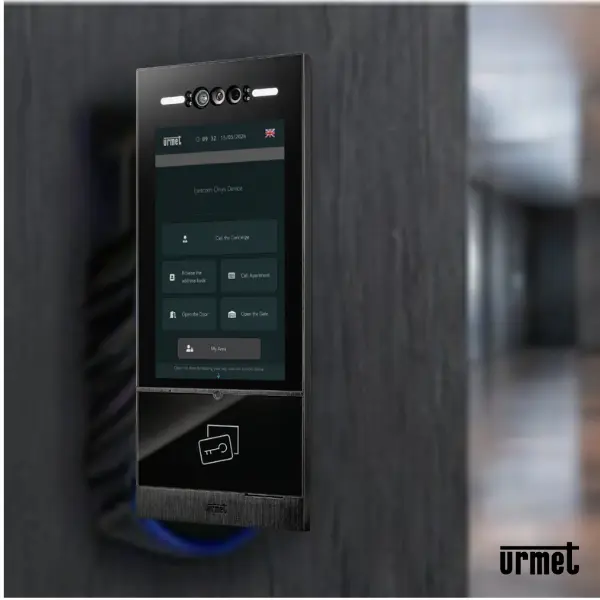
What to Look For in a Modern Video Door Station
If you’ve hung or specified door stations for any length of time, you already know the panel isn’t the hard part. Getting it on the wall is an afternoon. What matters is what that panel is doing three winters later. Is it still reading credentials in the cold, still clear on the screen in direct sun, and still not generating the service call that drags you back across town on a Friday?
In our experience, that’s usually what separates a good installation from one that keeps generating calls. And it’s the reason the conversation around door stations has changed.
We’ve been seeing these conversations come up more often. It isn’t that older door stations stopped working. Expectations changed. Building owners want more flexibility. Residents expect more convenience. And installers are looking for products that solve problems instead of creating them.
The bar for building entry has moved.
None of this is about any one product. It’s about a higher standard showing up on more and more projects:
- Building owners and architects now treat the entry panel as part of the building’s appearance, not a box bolted next to the door.
- Residents expect more than a key and a buzzer. They expect convenient, flexible ways to enter the building.
- Property managers want to handle visitors and day-to-day changes without sending someone to the site.
- And the people speccing and installing these systems want fewer callbacks and cleaner handoffs.
The panel you’ve been using for years may still be a good product. But today’s projects often ask it to do more than it was designed to do. So before we talk about any specific unit, here’s what we’d tell a customer to weigh.
What to look for in a modern door station
1. It has to survive outside. An entry panel lives in weather and takes daily abuse. That’s why ingress and impact ratings matter more than any single one feature: IP66 for weather, IK08 for impact, along with an operating range wide enough for a real winter and a real summer. Look at the camera too. A lens and screen that wash out in direct sun or go blind at night will generate complaints no spec sheet warns you about.
2. It should fit the infrastructure you already have. Power and mounting flexibility keep a clean install from turning into a rewire. A panel that runs on either PoE or low-voltage DC, mounts flush or on the surface, and sits on a standard network gives you options based on the wall and the building you actually walked into.
3. Relying on one way in can create headaches. When a keypad is the only option, every forgotten code is a lockout and every lost fob is a service call. Today’s buildings increasingly need more than one way to enter, whether that’s a code, a proximity fob, a face, or a QR, so a single lost or forgotten credential doesn’t become your problem to drive out and fix.
4. The entry method itself has to be secure. More convenient shouldn’t mean easier to beat. A photo held up to a camera shouldn’t open a door, and a lost fob shouldn’t hand someone the building. This is where liveness detection and two-factor entry separate a serious panel from a convenient one.
5. It has to talk to the rest of the system. The panel is one piece. The monitors inside the units, the app the manager uses, the way changes get pushed: if those don’t connect, you’ve sold a standalone gadget instead of a system, and the gaps come back as callbacks.
6. Visitors are their own problem. Deliveries, contractors, and one-time guests shouldn’t require a permanent credential or a phone call to the manager. Time-limited visitor passes solve a headache that keypads never addressed.
Appearance is now part of the spec. On more projects than not, building owners want an entry station that complements the architecture without giving up the features today’s occupants expect. Years ago that was a bonus. Today it’s often a requirement.
Where ONYX fits
That’s what caught our attention about URMET’s ONYX. It addresses many of the same priorities we’ve been hearing from customers: modern door entry, flexible credential options, dependable building security, and a design that fits today’s buildings.
See it in context
You’ve seen why the bar has moved and what separates a panel that lasts from one that doesn’t. Here’s how ONYX brings those pieces together in one unit.
How ONYX answers each of those
ONYX checks every box above. A few things set it apart:
- A photo won’t open the door. ONYX uses 3D face recognition with liveness detection for up to 10,000 faces, so it tells a real person from a picture or a video held up to the camera.
- Lose the fob, keep the security. Two-factor entry pairs a proximity key with a code or QR. If the key is lost or stolen, the door still won’t open to whoever finds it.
- Visitor passes built for real traffic. Issue single-use passes for deliveries, time-boxed passes for events, or recurring passes for regular service people, all from the app. No permanent credentials handed out, no call to the manager.
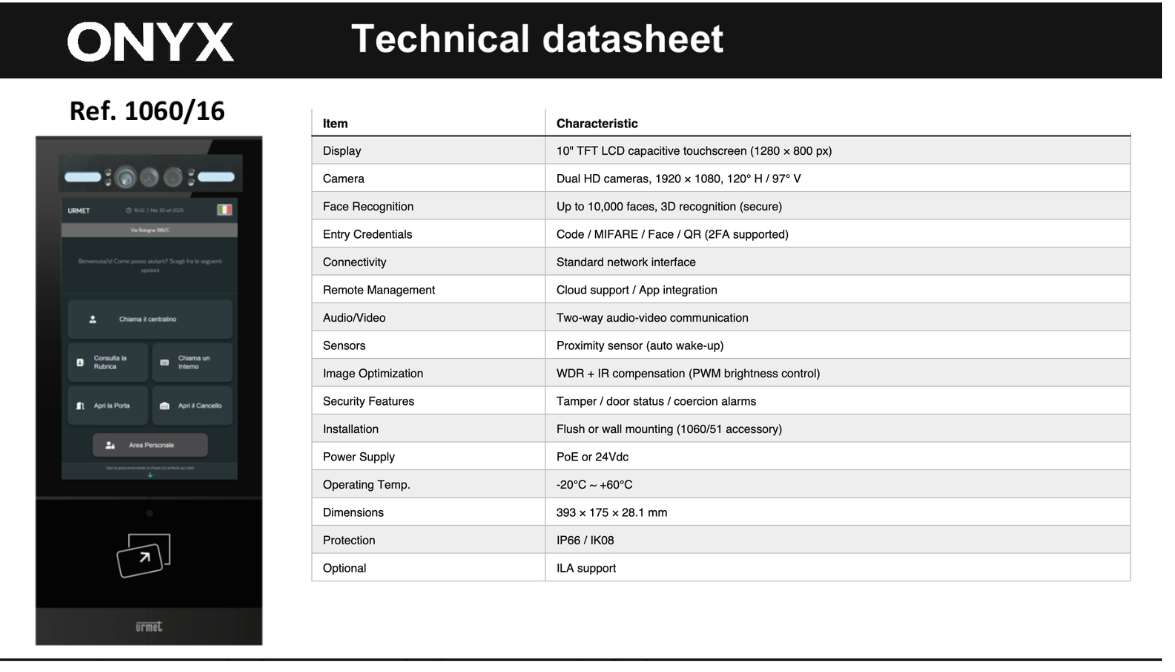
- The fundamentals are covered. IP66 and IK08 with a −20°C to +60°C range for the weather, PoE or 24Vdc and flush or wall mounting for the install, a 10″ touchscreen and full-black finish for the look, and two-way audio and video to URMET’s VOG7 and MAX10 monitors.
Full specs are on the datasheet, Ref. 1060/16.
If you’ve been doing this a while, you know the best products aren’t the ones with the longest spec sheet. They’re the ones that go in clean, hold up, and leave both the installer and the customer happy. That’s the lens we bring to every line we carry.
If you’re planning entry systems for an upcoming project…
It’s a lot easier to size up a new panel before the job starts than after it’s on the wall, and the next project is the natural time to do it. If the panel you reach for by default is the same one you were installing five years ago, it’s worth a look before you commit the spec.
If you’re planning new construction or updating an existing property across Westchester, the NYC boroughs, Long Island, New Jersey, or Eastern PA, we’d be glad to show you ONYX, answer your questions, and help you decide whether it’s the right fit for your next project. No hard sell, just a straight read from people who’ve been doing this a while.
Call 732-977-9295 or reach us at bob@chartrandassociates.com. Spec reference: ONYX Ref. 1060/16